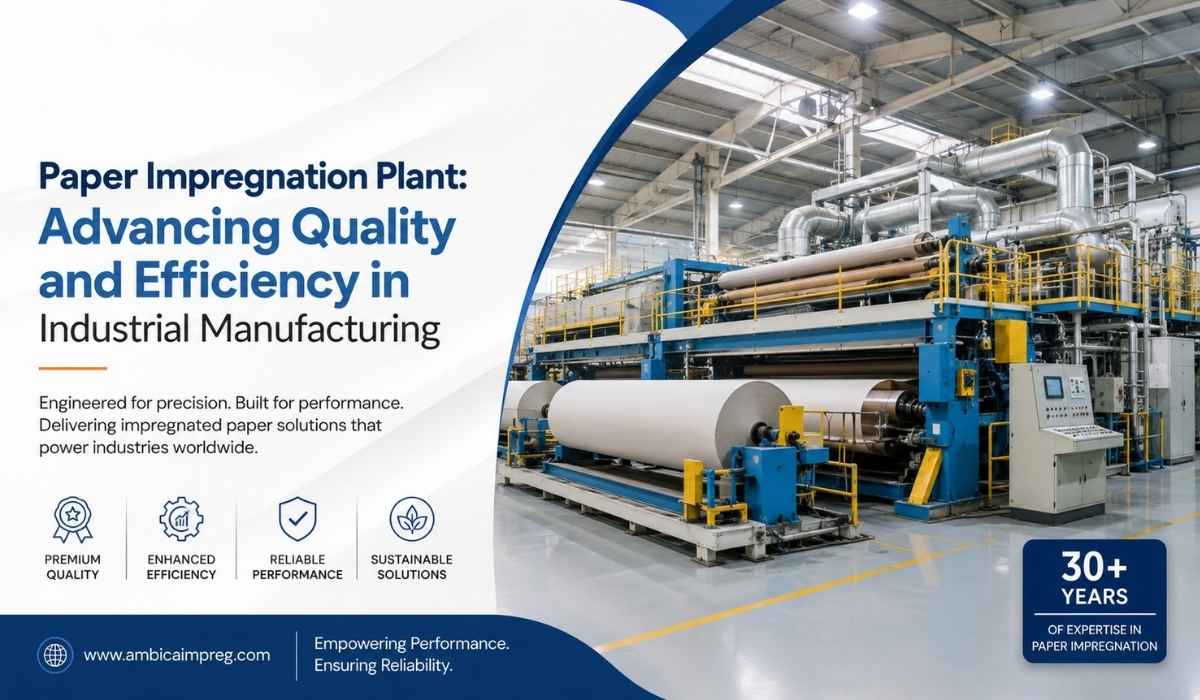
In industries that manufacture decorative laminates, insulation materials, and engineered panels, consistency in material treatment plays a critical role in product performance. Paper impregnation is a specialized process that enhances the strength, durability, and functional properties of paper by saturating it with carefully selected resins. A modern paper impregnation plant enables manufacturers to achieve uniform resin distribution, controlled drying, and dependable production quality while supporting high-volume operations. With increasing demand for precision and efficiency, investing in advanced processing technology helps businesses maintain quality standards, reduce waste, and improve production outcomes across various industrial applications.
Understanding the Paper Impregnation Process
The impregnation process involves passing paper through resin baths before drying and curing it under controlled conditions. This treatment enhances the paper’s physical properties, making it suitable for demanding industrial applications.
Key stages typically include:
- Resin preparation and mixing
- Controlled paper feeding
- Uniform resin saturation
- Drying and curing
- Quality inspection
- Roll collection and storage
Each stage contributes to achieving consistent product performance while minimizing production variations and material loss.
Selecting the Right Impregnation Plant for Production Goals
Choosing an impregnation plant requires evaluating operational requirements rather than focusing only on production capacity. The right equipment should align with manufacturing objectives, product specifications, and long-term efficiency goals.
| Production Requirement | Machine Capability | Business Advantage |
| High daily output | Continuous processing line | Increased productivity |
| Consistent resin application | Precision coating control | Uniform product quality |
| Multiple paper grades | Flexible operating settings | Greater production versatility |
| Energy optimization | Efficient drying system | Lower operating costs |
| Quality monitoring | Automated process controls | Reduced production errors |
Matching machine capabilities with production needs helps manufacturers improve efficiency while maintaining consistent product quality.
Industries That Benefit from Paper Impregnation Technology
Paper impregnation supports numerous industries where treated paper improves the durability and performance of finished products. Different sectors rely on specialized processing to meet specific manufacturing standards.
Common applications include:
- Decorative laminate production
- High-pressure laminate manufacturing
- Electrical insulation materials
- Furniture surface materials
- Construction panel manufacturing
- Industrial composite products
The versatility of treated paper allows manufacturers to produce materials that meet demanding technical and aesthetic requirements across diverse markets.
How Modern Impregnation Machines Improve Productivity
Advanced impregnation machines are designed to enhance operational stability while supporting consistent manufacturing quality. Modern automation systems reduce manual intervention and improve process accuracy throughout production.
Important technological advantages include:
- Automated tension control
- Accurate resin dosing
- Consistent drying temperatures
- Digital production monitoring
- Faster changeover between production batches
- Improved process repeatability
These innovations help manufacturers optimize workflow, minimize downtime, and maintain reliable production performance even during extended manufacturing cycles.
Planning for Long-Term Operational Success
Purchasing industrial equipment is a long-term investment that extends beyond initial production requirements. Successful operations depend on selecting machinery that can adapt to future manufacturing demands while maintaining reliability.
Manufacturers should focus on:
- Scalable production capabilities
- Preventive maintenance planning
- Operator training programs
- Process optimization
- Regular equipment inspections
- Continuous quality improvement
A proactive operational strategy helps maximize equipment lifespan while ensuring stable production performance and consistent product quality.
Frequently Asked Questions
1. What is the purpose of paper impregnation?
Paper impregnation improves the strength, durability, and functional properties of paper by treating it with specialized resins for industrial applications.
2. Which industries commonly use impregnated paper?
It is widely used in laminate manufacturing, electrical insulation, furniture production, construction materials, and engineered composite applications.
3. Why is process consistency important during impregnation?
Consistent processing ensures uniform resin distribution, reliable product quality, and reduced manufacturing defects.
4. What should manufacturers consider before selecting equipment?
Production capacity, automation features, energy efficiency, product compatibility, quality control systems, and future expansion requirements should all be evaluated.
5. How does automation improve paper impregnation operations?
Automation enhances production accuracy, reduces manual errors, improves monitoring, and supports consistent manufacturing performance.
Conclusion
Paper impregnation technology continues to play an important role in manufacturing high-performance industrial materials by improving product consistency, durability, and production efficiency. Choosing equipment that aligns with operational goals allows manufacturers to achieve dependable results while adapting to evolving market demands. Working with experienced paper impregnating plants manufacturers supports long-term manufacturing success through reliable engineering and efficient production solutions. Ambica Industries recognizes the importance of delivering advanced impregnation technology that helps industries achieve precision, operational stability, and sustainable manufacturing performance.